The Commuter Read: Choosing a Book That Survives a Stop-Start Journey
Choose a commuter read by matching chapter length, narrative density and interruption tolerance to your route, so missed stops and broken concentration matter less.
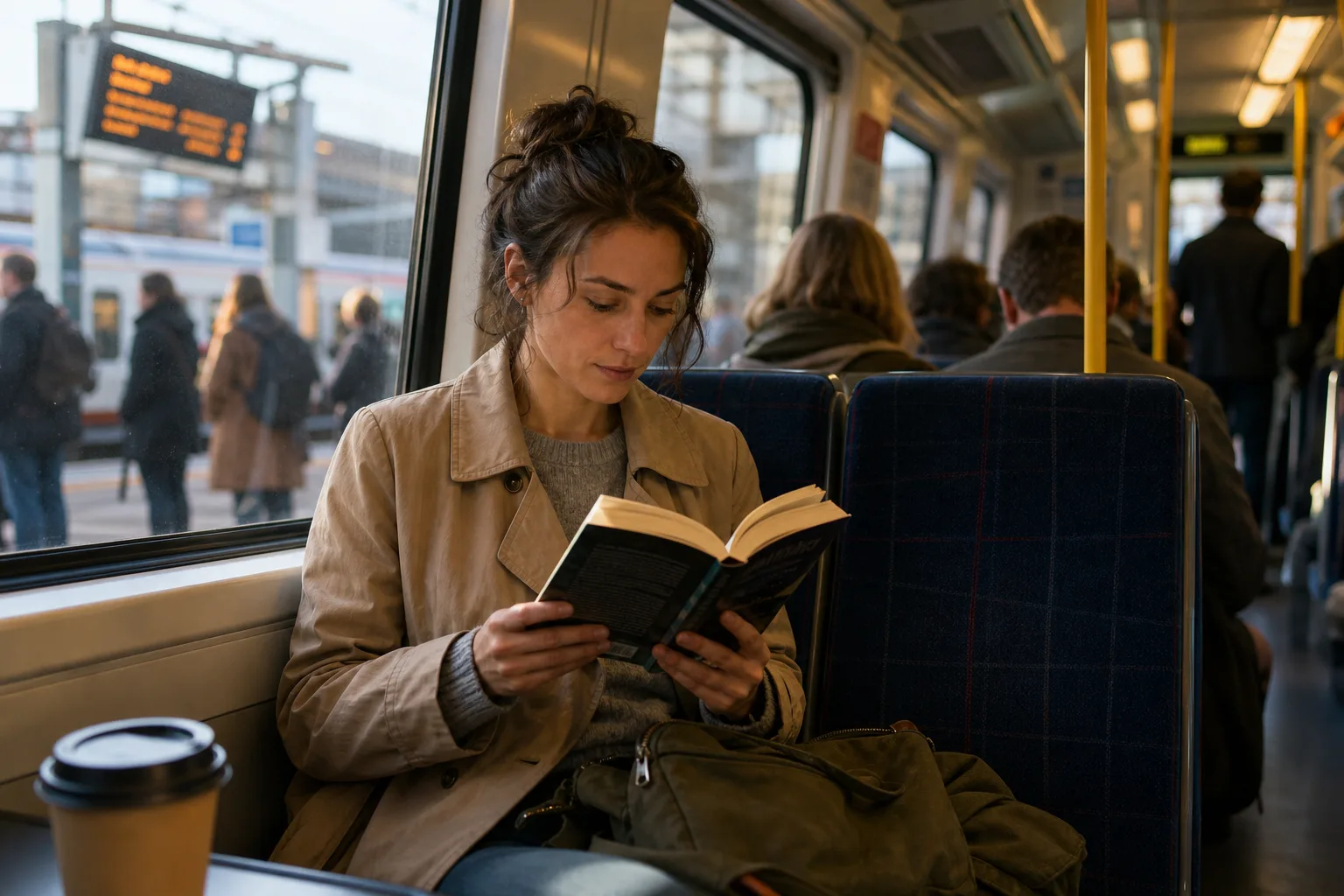
A commuter read needs to survive a train announcement halfway through a scene, a bus queue that moves at last, and the awkward business of getting off with a book open. Choosing a commuter read is less about finding a short book than finding one whose shape suits the way your journey keeps stopping.
When a book feels difficult on the way to work, the cause is often a mismatch: chapters demand more uninterrupted attention than the route allows, or the story takes too long to become legible again after a pause. The fixes are practical. Notice where the reading breaks, identify what the book asks you to hold in mind, then choose a format and pace that fit.
Why do you lose the thread between stops?
A stop-start journey divides attention into small, uneven stretches. You may have several calm pages, then need to check a platform display, move for another passenger or listen for an announcement. A book that depends on remembering a long chain of names, clues or shifts in viewpoint can make each return feel like a small examination.
Narrative density matters more than the book’s reputation for being “easy”. A spare novel with short chapters may still ask you to track a complicated timeline. A long book can be perfectly manageable if its scenes have clear beginnings and its characters remain easy to place.
Notice the exact point where you hesitate after a pause. If you can resume by rereading the last paragraph, the interruption is probably not the problem. If you need to revisit several pages to work out who is speaking or why a decision matters, the book may be asking for more continuity than this route provides.
Keep a note of the last character or event if the story has a crowded cast.
Are the chapters too long for the journey?
Long chapters are not automatically unsuitable, but they can create a poor stopping point when your travel time is unpredictable. If the next scene begins before your stop, you may keep reading while preparing to leave, or abandon the page at an awkward moment. Neither is a moral failure; one is simply an inconvenient chapter break.
Look for internal divisions as well as chapter length. Scene breaks, dated entries, alternating narrators and brief sections can all offer natural places to pause. A novel with substantial chapters but clear scene transitions may suit a commuter better than a book of short chapters whose paragraphs run through several changes of setting.
Try the book on a journey and stop at the first interruption that feels natural. If you repeatedly have to stop mid-conversation or midway through an explanation, put a bookmark at a scene boundary and use that as your personal stopping point. Some editions also make this easier through generous spacing or visible section breaks.
For a route with frequent changes, prefer books that give you more than one sensible place to pause.
Does the story take too much effort to pick up again?
Some books rely on accumulated detail. A family saga may introduce relatives across several households; a mystery may plant clues whose significance becomes clear much later; a formally inventive novel may shift time or narrator without warning. These can be rewarding reads, but the pleasure may depend on being able to keep the pieces in view.
That does not mean the train is reserved for plot-heavy novels with one character and a clear destination. It means matching the book’s demands to your own interruption tolerance. If you enjoy reconstructing a complicated story after a pause, density may be part of the appeal. If returning to the page feels like being handed unfinished paperwork, choose a book with stronger scene-level cues.
Say you have a journey with two changes and often lose your place while checking platform information. You choose a collection of linked stories with distinct settings rather than a mystery that builds through a large cast; after each interruption, the change of scene makes the return point easier to recognise. The likely result is not effortless reading, but less time spent rebuilding context.
When you are choosing in a bookshop or library, read a page from the middle, not only the opening. Ask whether you can identify the speaker, situation and immediate aim without studying every sentence.
Would a different format make the book easier to carry?
Physical size can affect the experience as much as the writing. A large hardback may be awkward to hold on a crowded bus, while a paperback with a flexible cover can fold into a coat pocket more readily. A smaller book is not always more comfortable, though: cramped type or a narrow gutter can make reading on a moving vehicle tiring.
An e-reader can keep several books available without adding much bulk, and adjustable type may help when light or seating is poor. Its screen, battery and controls are additional things to manage, so consider whether that suits your route. A paperback avoids charging but may be inconvenient if you need both hands free while standing.
Choose the format you can use without turning the journey into an equipment exercise. If you already carry a bag, check whether the book sits securely and can be reached without unpacking everything at the stop.
What should you do when your current book is not working?
Before abandoning it, separate a temporary slow patch from a persistent mismatch. A book may take time to establish its characters, or you may simply be reading it on a day when the carriage is noisy. Try changing one thing at a time: the stopping point, the place you sit, or the amount you read before the journey begins.
- You keep rereading the same page: Move to a quieter seat if possible, or save the most demanding passage for a calmer part of the day.
- You cannot remember who is who: Use the dramatis personae or a small note of names and relationships, if the edition provides one.
- You stop at the worst moment: Mark a nearby scene break before the next leg, rather than waiting for the chapter to end.
- The book feels slow after every pause: Try a self-contained chapter or a separate short story for the rest of the route.
- The format is awkward to handle: Borrow or buy a different edition, or switch to a device you can hold comfortably.
Give a change enough time to show whether it helps. If the book still makes every return feel laborious, save it for a place where you can read in longer stretches; a different book is a reasonable travel companion, not a verdict on the first one.
Which commuter read questions are worth asking?
Are short chapters always better for commuting?
No. Short chapters offer frequent stopping points, but they may still contain dense prose, multiple narrators or unresolved transitions. Look for clear scene boundaries and easy re-entry, not chapter length alone.
Is a familiar book a good choice for a busy route?
Often, if recognition makes it easier to resume after interruptions. A reread can also hold your attention less firmly than a new book, which may suit a journey where you need to look up often.
Should I save a complicated novel for home?
Save it if interruptions repeatedly make the reading feel like reconstruction rather than discovery. If you enjoy piecing things together and can keep a brief note, the commute may still suit it.
What makes a good book for a journey with several changes?
Choose one with clear transitions, a manageable cast and natural pauses, or carry a collection of independent pieces. The best choice is the one you can resume without needing to remember the whole route of the plot.
How can you choose before leaving home?
Think about the route as it usually is, not as you hope it might be. A quiet direct train gives you room for a layered novel; a crowded journey with transfers may favour distinct scenes, a familiar reread or short fiction. Your mood matters too: some readers welcome a puzzle, while others want the page to make sense again at a glance.
For a commuter read, consider chapter and scene breaks, narrative density, interruption tolerance, physical comfort and how quickly you can re-enter the story. You do not need a book that behaves like a timetable. You need one that leaves a useful place to stop, and a clear enough path back when the doors open again.
Keep reading

Audio at the Crosswalk: Set Up an Audiobook Session You Can Pause
Set up a pausable audiobook session that is easier to resume between errands, with controls, downloads…

Twenty Minutes Before Bed: Make a Reading Slot Feel Complete
A twenty-minute reading slot before bed can feel complete without a strict routine: choose a natural…