How Book Borrowing Changed from Private Collections to Public Libraries
Book borrowing shifted from private collections to civic lending, while membership rules and local barriers shaped who could read shared books.
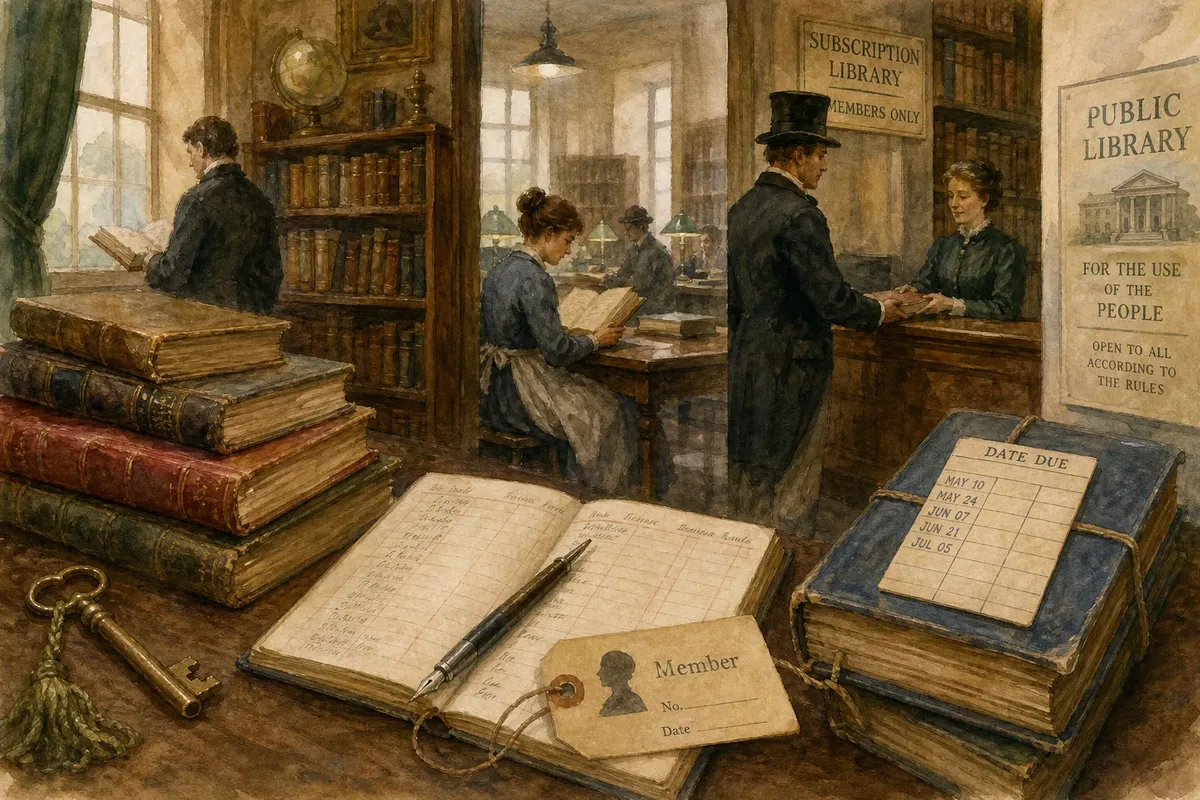
The most common mistake in telling the history of book borrowing is to treat public libraries as if they opened their doors to everyone at once. That neat story hides a more useful question: who set the rules, and which readers could use the collection? Book borrowing changed gradually, with access shaped by each institution and community.
Book borrowing began with collections controlled by institutions and owners
For much of book history, making and keeping books required resources, so collections were associated with institutions and households that could maintain them. Rulers, religious communities, schools, scholars, and wealthy families all kept books, but ownership did not automatically mean open entry or permission to borrow.
Access depended on the purpose of a collection and the decisions of those who controlled it. A reader connected to a school or religious community might have options that a visitor or outsider did not.
Think of a shared collection as a cupboard with one key. Several people may use what is inside, but the person who holds the key still decides who gets access.
Reading rooms let readers consult books without taking them home
Some libraries and reading rooms made books available for use on site. Readers could consult a work without owning it, but they had to reach the room and fit their visit around its rules and hours.
Imagine an invented apprentice working at a print shop who has a short break and visits a reading room. She consults a book she cannot buy, then leaves it there when she returns to work. The observable result is access to that text during her visit, not the freedom to read it at home.
Subscription libraries made lending a member benefit
Subscription libraries organized a shared collection for people who paid dues, bought shares, or otherwise qualified for membership. Members could borrow books in turn rather than acquire every title individually.
This model made lending a regular arrangement, but the conditions mattered. Fees and membership rules could exclude people, so a shared collection was not necessarily a broadly accessible one.
Public libraries expanded the civic purpose of lending
Public libraries developed through different local histories rather than through one universal change. In communities that established publicly supported libraries, lending could be framed as a civic service instead of a benefit limited to members of a private association.
The label “public” did not mean that every resident had equal access. Laws, institutional policies, segregation, discrimination, and practical barriers could limit who entered or borrowed. Readers and communities challenged such restrictions, and some communities established separate institutions in response. Those details belong in the history alongside the broader civic aim.
When describing a particular library, distinguish what its rules said from what readers could actually do. Local records and reliable accounts can help establish who was eligible, what barriers existed, and when policies changed; without those sources, avoid presenting a general account as the history of every place.
Circulating books depend on shared rules and collection choices
A borrowed book moves from one reader to another, and libraries use lending and return rules to keep materials available for future use. The everyday routine depends on cooperation: a borrower takes a book temporarily and returns it so someone else can use it.
Access also depends on what a collection contains. Language, subject, format, and audience all shape whether readers can find books that meet their interests and needs. Borrowing is not only a question of reaching the shelves; it is also a question of what is on them.
What shaped access to books?
Did early libraries lend books to everyone?
No single answer applies to every early collection. Access depended on who controlled it and whether a reader’s status, affiliation, or relationship to the institution met its rules.
How did subscription libraries work?
Members contributed money or otherwise qualified to use a shared collection, often borrowing books in turn. Fees and membership conditions determined who could participate.
Did public libraries give everyone equal access?
Not automatically. Public purposes could coexist with exclusionary laws, policies, or local practices, so the history of a specific library requires attention to its community and rules.
Why does the history of book borrowing matter?
It shows that access depends on decisions about eligibility, funding, and collection contents. The simple act of taking a book home rests on shared arrangements that can include some readers and leave others out.
Compare the conditions that determined who could borrow
When you read a description of a library or collection, identify the condition that shaped a reader’s options. Each observation points to a different question about access.
- Private collection: Observe who owns the books and controls entry. If an owner’s permission is required, then note that access depends on that owner; otherwise, identify the institution or policy that sets the terms.
- Institutional collection: Observe whether use requires a connection such as student or member status. If affiliation is required, then identify who falls outside it; otherwise, check who governs access and for what purpose.
- Reading room: Observe whether readers can take books home. If books must stay on site, then consider how location and opening hours limit use; otherwise, examine the lending rules.
- Subscription library: Observe whether payment or membership is required. If so, then identify who may be unable to join; if not, check how the collection is funded and who makes its rules.
- Public library: Observe the stated eligibility rules and any documented barriers. If a group faced restrictions, then include them in the account; otherwise, describe the evidence for how access was defined.
- Circulating book: Observe what borrowers must do to return a book. If return makes it available to another reader, then describe that shared arrangement; otherwise, identify the rule that keeps materials in circulation.
- Collection choices: Observe which languages, subjects, and formats appear. If a reader’s needs are missing, then ask what selection decisions may explain the gap; otherwise, describe whom the collection serves.
Say you are comparing two invented library descriptions. The first states that members pay dues before borrowing. The second says residents may borrow under shared rules, but its local account documents that a group of residents was excluded. You record membership as the first library’s condition, then record both the second library’s stated eligibility and its documented barrier. Your resulting comparison is specific: the civic library describes a broader basis for access, while local practice still restricted who could use it.
Book borrowing history makes local access easier to see
The history of book borrowing is not a simple march from closed shelves to equal access. It is a record of changing institutions, rules, and collection decisions, with each community shaping what “public” meant in practice.
On your next library visit, notice the lending rules and the kinds of books represented alongside the title you borrow. That small observation can help you see how an ordinary reading moment connects to the continuing choices behind a shared collection.
Keep reading

Why a Familiar Reading Spot Makes It Easier to Begin
A familiar reading spot can make starting easier: choose a place that fits your day, keep…

Paper, E-Reader, or Audio: Choosing a Format for the Moment
Choose a reading format for the moment by matching print, an e-reader, or audio to your…